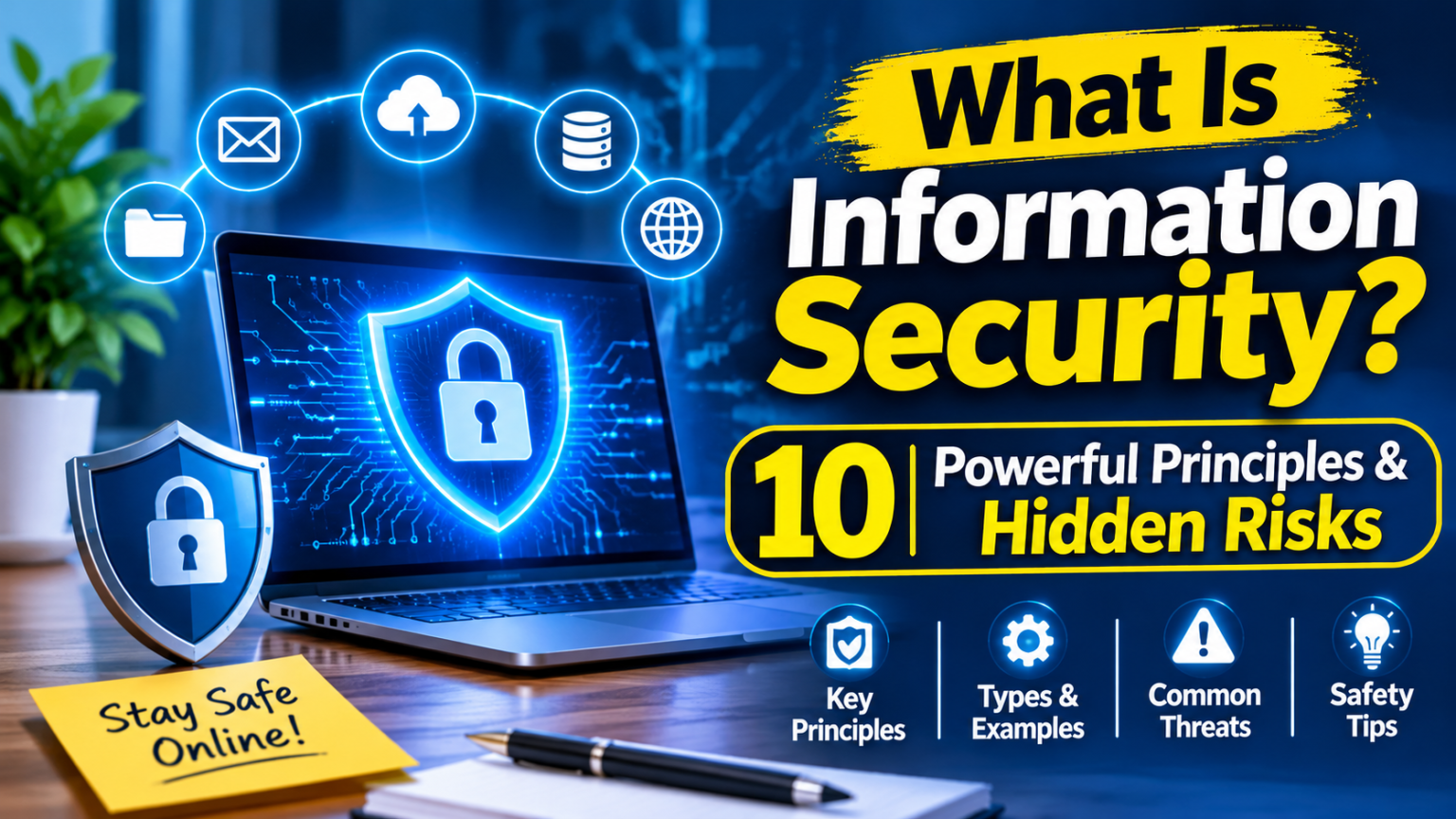
What is information security? It is the practice of protecting important information from unauthorized access, theft, misuse, alteration, or destruction. Whenever someone sends an email, saves a document, makes an online payment, or stores customer details, information security helps keep that data safe.
Today, individuals and businesses depend on digital information for everyday activities. However, cyberattacks, human mistakes, weak passwords, and system failures can put sensitive data at risk. Understanding information security helps people recognize these threats and take practical steps to prevent them.
This beginner-friendly guide explains what information security means, why it matters, its main principles, different types, common threats, and real-world examples.
What Is Information Security?
Information security, often called InfoSec, refers to the policies, processes, and technologies used to protect information and the systems that store, process, or transmit it.
Its main purpose is to ensure that information remains private, accurate, and available to authorized users whenever needed.
According to the National Institute of Standards and Technology (NIST), information security protects information and information systems against unauthorized access, use, disclosure, disruption, modification, or destruction.
Information security applies to both digital and physical information. For example:
- A hospital protects patients’ medical records.
- A bank secures customers’ account information.
- A company limits access to confidential business documents.
- A school protects students’ personal and academic records.
- An individual uses passwords to secure personal devices.
In simple terms, information security makes sure that the right people can access the right information without exposing it to unauthorized individuals.
Why Is Information Security Important?
Information is valuable. Personal details, financial records, business plans, passwords, and customer databases can cause serious problems if they fall into the wrong hands.
Information security helps individuals and organizations reduce these risks while maintaining trust and reliable operations.
1. Protects Sensitive Information
Personal and business information should only be accessible to authorized people. Security controls help prevent strangers, criminals, or unauthorized employees from viewing confidential records.
2. Prevents Financial Loss
Data breaches, fraudulent transactions, ransomware, and business interruptions can create financial damage. Strong security measures help reduce the possibility and impact of these incidents.
3. Maintains Customer Trust
Customers expect businesses to handle their personal details responsibly. Protecting their information supports confidence in a company’s products and services.
4. Supports Business Continuity
A security incident can interrupt normal business activities. Backups, recovery plans, and access controls help organizations restore important information and continue operating.
5. Helps Meet Legal and Regulatory Requirements
Many industries must follow privacy and data protection requirements. Effective information security practices help organizations manage their responsibilities and reduce compliance risks.
What Are the 3 Main Principles of Information Security?
The three fundamental principles of information security are known as the CIA triad. CIA stands for Confidentiality, Integrity, and Availability. These principles help organizations decide how to protect their information.
1. Confidentiality
Confidentiality means keeping information private and preventing unauthorized people from accessing it.
For example, only an authorized bank employee should be able to view a customer’s financial records. Passwords, encryption, and access permissions help maintain confidentiality.
2. Integrity
Integrity ensures that information remains accurate, complete, and protected from unauthorized changes.
For instance, a hospital must maintain accurate patient records. If someone changes a patient’s medication details without permission, it could create serious consequences.
Organizations use access controls, validation checks, audit logs, and secure backups to protect data integrity.
3. Availability
Availability means ensuring that authorized users can access information and systems when they need them.
Imagine an online banking service becoming unavailable during an important transaction. This situation affects customers and business operations.
Regular maintenance, backup systems, disaster recovery plans, and reliable infrastructure help maintain availability.
Together, these three principles create the foundation of an effective information security strategy.
What Are the Different Types of Information Security?
Information security includes several areas that protect different forms of information and technology. The following types are commonly used by individuals and organizations.
1. Network Security
Network security protects computer networks from unauthorized access, harmful traffic, and attacks. Firewalls, network monitoring, and secure connections help prevent suspicious activity.
2. Application Security
Application security focuses on protecting software and applications from weaknesses that attackers may exploit.
Developers use secure coding, software updates, testing, and access controls to reduce application vulnerabilities.
3. Data Security
Data security protects information while it is stored, processed, or transferred. Encryption, secure backups, and data access permissions are common methods.
4. Physical Security
Physical security protects devices, servers, documents, and facilities from physical theft, damage, or unauthorized entry.
For example, a company may use security cameras, locked server rooms, ID cards, and restricted office access.
5. Cloud Security
Cloud security protects information and services stored on cloud platforms. It involves identity management, encryption, secure configurations, monitoring, and proper access permissions.
6. Operational Security
Operational security focuses on the everyday procedures people follow to handle sensitive information safely. It includes security policies, employee responsibilities, data handling rules, and incident response procedures.
What Are the Characteristics of Information Security?
An effective information security system has several important characteristics beyond the basic CIA triad.
- Authentication: Confirms the identity of a user, device, or system before access is granted.
- Authorization: Determines which information or resources an authenticated user can access.
- Accountability: Helps track actions so users and systems can be held responsible for their activities.
- Non-repudiation: Provides evidence that an action or communication took place, making it difficult for someone to deny their involvement.
- Reliability: Helps ensure that information systems perform their intended functions consistently.
- Privacy: Supports the appropriate collection, use, and protection of personal information.
These characteristics work together to make information systems more dependable and secure.
Common Information Security Threats You Should Know
Information security threats can come from external attackers, dishonest insiders, technical weaknesses, or accidental mistakes. Recognizing common threats is an important step toward preventing them.
1. Phishing Attacks
Phishing involves deceptive emails, messages, or websites designed to trick people into sharing passwords, financial details, or other sensitive information.
2. Malware
Malware is harmful software designed to damage systems, steal information, or gain unauthorized access. Viruses, spyware, and ransomware are common examples.
3. Ransomware
Ransomware locks or encrypts files and may demand payment to restore access. Regular offline or protected backups can help organizations recover from these attacks.
4. Insider Threats
An insider threat occurs when someone with legitimate access intentionally or accidentally exposes sensitive information.
5. Weak Passwords
Simple, reused, or easily guessed passwords make accounts easier to compromise. Strong unique passwords and multi-factor authentication reduce this risk.
6. Data Breaches
A data breach happens when sensitive information is accessed, disclosed, or exposed without authorization. It may result from hacking, poor security practices, or human error.
10 Powerful Information Security Practices for Better Protection
Individuals and organizations can improve information security by following practical habits. These steps do not remove every threat, but they can reduce common security risks.
- Use strong passwords: Create unique passwords for important accounts and avoid sharing them.
- Enable multi-factor authentication: Add another verification step wherever possible.
- Install software updates: Keep operating systems, applications, and security tools updated.
- Back up important files: Maintain protected backups and test whether you can restore them.
- Encrypt sensitive data: Use encryption to protect information stored on devices or transferred across networks.
- Limit user access: Give employees and users only the permissions they need.
- Train employees: Teach staff how to identify phishing, suspicious links, and unsafe requests.
- Secure networks: Use firewalls, trusted Wi-Fi connections, and appropriate network protections.
- Monitor unusual activity: Review account access and system logs to identify suspicious behavior.
- Create an incident response plan: Decide how to report, investigate, contain, and recover from security incidents.
For a more practical explanation of everyday protection methods, read our guide to information security and ways to defeat cyber risks. It explores useful steps such as stronger passwords, multi-factor authentication, encryption, backups, and safer network practices.
Advantages and Disadvantages of Information Security
Information security offers important benefits, but implementing and maintaining it also requires planning and resources.
Advantages
- Better data protection: Reduces the risk of unauthorized access and information theft.
- Improved trust: Helps customers feel more confident when sharing personal details.
- Business stability: Supports reliable operations and recovery after incidents.
- Risk management: Helps organizations identify weaknesses before they become serious problems.
- Better control: Allows businesses to manage who can access sensitive information.
Disadvantages and Challenges
- Implementation costs: Security software, trained professionals, and infrastructure can require significant investment.
- Ongoing maintenance: Systems need regular updates, monitoring, and testing.
- Employee training: Staff members need time and guidance to follow security policies.
- Access restrictions: Strict controls can sometimes slow down legitimate work.
- No complete guarantee: Even well-protected systems can experience security incidents.
The best approach is to balance security with usability. A well-planned strategy protects important information without making everyday work unnecessarily difficult.
Real-World Examples of Information Security
Information security is not limited to large technology companies. It is used in everyday situations across different industries.
Banking: Banks use encryption, authentication, transaction monitoring, and access controls to protect financial information.
Healthcare: Hospitals restrict access to patient records and use security procedures to protect confidential medical details.
Education: Schools and universities protect student records, examination results, and staff information through account permissions and secure databases.
Online shopping: E-commerce websites use secure payment processes and data protection measures to safeguard customer information.
Personal devices: Smartphone users protect their photos, messages, and accounts with screen locks, passwords, device updates, and backups.
These examples show how information security supports privacy and reliability in daily life.
How Can Beginners Start Learning Information Security?
People interested in information security can start with basic concepts before moving toward advanced technical skills.
- Learn the CIA triad and understand confidentiality, integrity, and availability.
- Study common threats such as phishing, malware, and social engineering.
- Understand basic networking, operating systems, and access management.
- Practice using strong passwords, multi-factor authentication, and secure backups.
- Explore beginner-friendly courses, books, and trusted educational resources.
- Learn about security policies, risk management, and incident response procedures.
Building these skills takes time, but consistent learning can help shape your professional digital destiny in an increasingly connected world.
Frequently Asked Questions About Information Security
1. What is information security in simple words?
Information security means protecting information from unauthorized access, misuse, changes, damage, or loss. It helps keep data private, accurate, and available to authorized users.
2. What are the three main principles of information security?
The three main principles are confidentiality, integrity, and availability. Together, they are known as the CIA triad.
3. Why is information security important?
It helps protect personal information, financial records, business data, and customer details. It also reduces the likelihood and potential impact of security incidents.
4. What are the main types of information security?
Common types include network security, application security, data security, physical security, cloud security, and operational security.
5. What is the difference between information security and cybersecurity?
Information security protects information in both physical and digital forms. Cybersecurity focuses more specifically on protecting digital systems, networks, devices, and data from cyber threats. Their responsibilities overlap, but their scope is not exactly the same.
Conclusion
Understanding what is information security is essential for anyone who uses digital devices, manages business information, or handles sensitive records. It involves protecting information against unauthorized access, disclosure, modification, and destruction.
The CIA triad—confidentiality, integrity, and availability—provides the foundation for information protection. Different types of security, including network, application, data, physical, and cloud security, help address specific risks.
By using strong passwords, enabling multi-factor authentication, updating software, maintaining backups, and educating users, individuals and organizations can build stronger protection. Information security is not a one-time task; it is an ongoing responsibility that helps keep information safe and accessible.