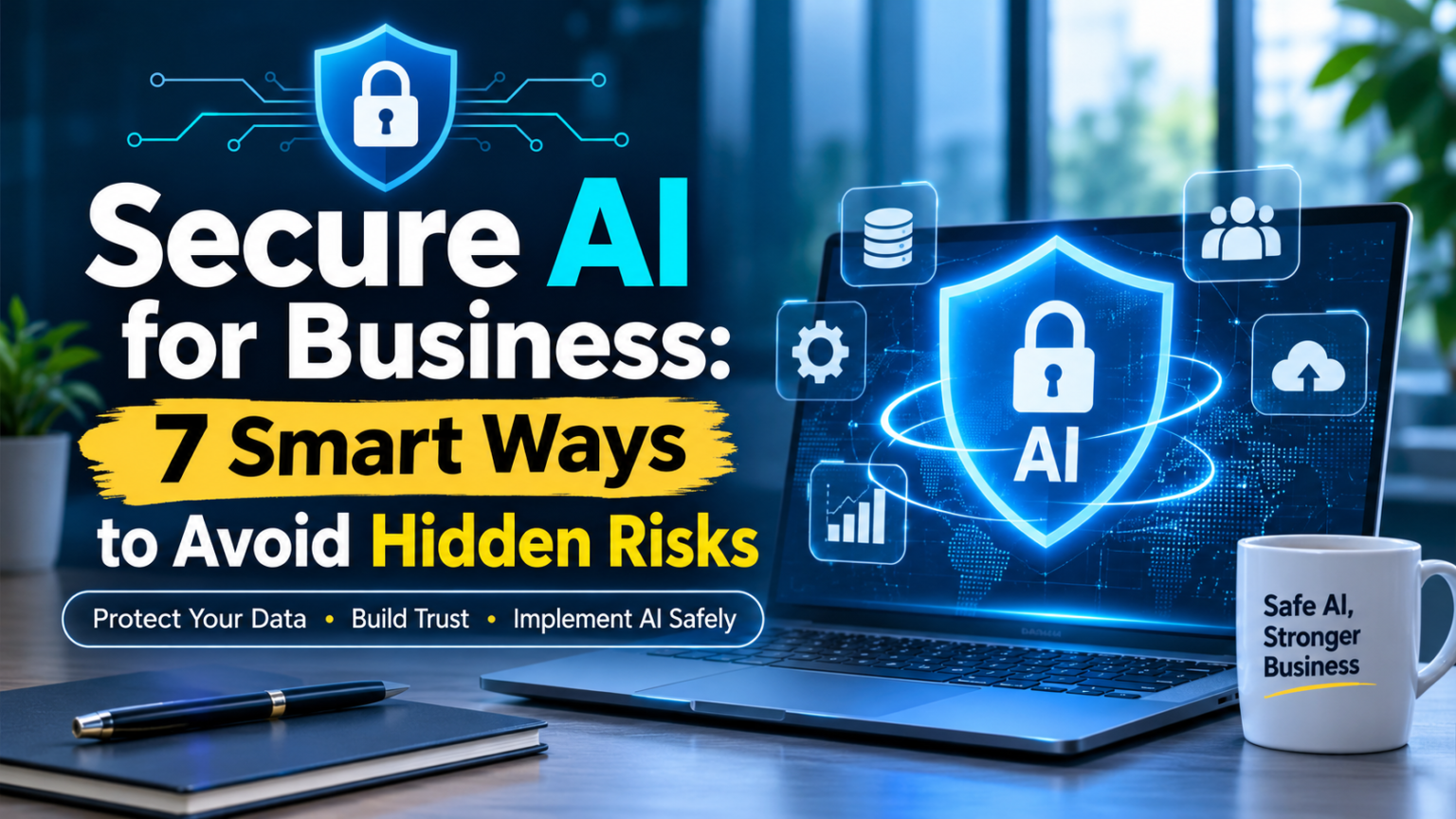
AI is changing how businesses operate, communicate, and make decisions. From customer support chatbots to automated data analysis, artificial intelligence helps organizations save time, improve productivity, and deliver better services. However, adopting AI without proper security measures can expose sensitive information, create privacy concerns, and introduce new cybersecurity threats.
Secure AI for business means using artificial intelligence solutions while protecting company data, customer information, digital systems, and business operations. It involves choosing trustworthy AI tools, controlling access, monitoring how information is processed, and establishing clear security policies.
Businesses should not focus only on what AI can accomplish. They must also understand what could go wrong when employees use AI platforms without proper guidance. A single mistake, such as uploading confidential documents to an unapproved chatbot, may create serious consequences.
The way organizations manage AI today may even influence their digital destiny. Therefore, building a secure AI strategy is not simply a technical decision. It is an important part of responsible business growth.
This guide explains how companies can protect their information, implement AI safely, understand potential risks, and build a reliable AI environment.
What Does Secure AI for Business Mean?
Secure AI for business refers to the safe adoption, development, and management of artificial intelligence technologies within an organization. Its primary goal is to help businesses benefit from AI without exposing sensitive information or weakening their cybersecurity defenses.
AI systems often process different types of information, including customer records, financial documents, employee details, internal reports, and business strategies. Without appropriate safeguards, this information may be exposed through insecure platforms, poor access controls, or data-handling mistakes.
A secure AI environment combines several important elements:
- Data protection: Keeping confidential information safe during AI processing.
- Access management: Allowing only authorized employees to use specific AI systems and information.
- Privacy controls: Preventing unnecessary collection, sharing, or exposure of personal information.
- Threat monitoring: Identifying suspicious activity and potential security problems.
- Responsible AI use: Ensuring AI-generated results are reviewed and used appropriately.
For example, a company using an AI chatbot for customer service should ensure that customer conversations are handled according to its privacy requirements. Employees should also understand which information they can share with the system.
The objective is simple: make AI useful without making business operations unnecessarily vulnerable.
Why Businesses Need Secure AI Solutions
AI adoption can improve business performance, but it also changes how organizations handle information. Every new AI application introduces potential security and privacy considerations.
Businesses need secure AI solutions for several important reasons.
1. Protect Confidential Business Information
Companies regularly handle sensitive information, such as contracts, financial records, product plans, and customer databases. Employees may unintentionally expose these details when entering information into public AI platforms.
Organizations should establish clear rules about which data employees can share with AI tools. Sensitive documents should only be processed through approved systems with suitable privacy and security protections.
2. Reduce Cybersecurity Threats
AI systems can become targets for cybercriminals. Attackers may attempt to manipulate AI applications, steal information, exploit weak integrations, or access connected business systems.
Strong security controls help businesses identify weaknesses before attackers can exploit them.
3. Maintain Customer Trust
Customers expect businesses to handle their personal information responsibly. If an organization exposes customer data through an insecure AI application, it may damage its reputation and customer relationships.
Secure AI practices demonstrate that a company takes privacy and information protection seriously.
4. Support Business Continuity
AI applications may become important parts of daily operations. If an AI service is compromised or unavailable, business activities could be interrupted.
Organizations should maintain backup procedures, alternative workflows, and incident response plans to reduce disruption.
7 Smart Ways to Implement Secure AI for Business
Implementing AI safely requires more than purchasing reliable software. Businesses need a practical strategy that covers technology, employees, data, and ongoing monitoring.
1. Choose Trusted AI Platforms
The first step is selecting AI tools that offer suitable security and privacy features.
Before adopting an AI platform, businesses should review its data-handling policies, encryption practices, access controls, retention settings, and security documentation.
They should also understand whether submitted information is used to train models and whether administrators can control how company data is stored or shared.
Avoid selecting AI software based only on popularity or low pricing. A platform should meet the organization’s security requirements and business needs.
2. Establish Strong Data Protection Policies
Data protection should remain a priority throughout the AI implementation process.
Businesses should classify information according to its sensitivity. Public information, internal documents, confidential records, and highly restricted data should not all receive the same level of access.
For example, employees may use approved AI tools to summarize public reports. However, uploading customer payment information or confidential contracts should require specific authorization and suitable technical safeguards.
Organizations should also consider:
- Encrypting sensitive information during storage and transmission.
- Removing unnecessary personal information before processing.
- Setting data retention and deletion rules.
- Limiting access to confidential business records.
- Reviewing how third-party AI providers handle submitted data.
These practices reduce the possibility of accidental information exposure.
3. Apply Role-Based Access Controls
Not every employee needs access to every AI application or company database.
Role-based access control allows organizations to assign permissions according to job responsibilities. For instance, marketing employees may need AI writing tools, while finance teams may require approved financial analysis applications.
Businesses should also use multi-factor authentication (MFA) wherever possible. MFA adds another verification step beyond a password, making unauthorized account access more difficult.
Regular permission reviews are equally important. When employees change roles or leave an organization, their previous access should be updated or removed.
4. Train Employees to Use AI Responsibly
Human mistakes remain an important security concern.
Employees may unknowingly share confidential information, rely on inaccurate AI-generated answers, or follow malicious instructions contained in external content.
Businesses should provide practical AI security training that explains:
- Which AI applications are approved.
- What information must never be shared.
- How to identify suspicious AI-generated content.
- Why important AI outputs require human review.
- How to report possible security incidents.
Training should not be limited to technical teams. Every employee who interacts with AI applications should understand the organization’s rules.
5. Monitor AI Systems and Their Activities
AI security does not end after implementation. Businesses need continuous monitoring to identify unusual activity and potential vulnerabilities.
For example, repeated attempts to access restricted information may indicate an account compromise. Unexpected data transfers could also suggest a problem with an AI integration.
Organizations should monitor system activity, review security logs, investigate unusual behavior, and update software regularly.
Security teams should also test AI applications before major updates or changes to their integrations. This helps identify weaknesses that may appear as the technology evolves.
6. Secure Third-Party AI Integrations
Many businesses connect AI applications with existing software, including customer relationship management systems, cloud storage, email platforms, and internal databases.
These integrations can improve productivity, but they may also create additional entry points for attackers.
Before connecting an AI tool to another system, organizations should:
- Verify the third-party provider’s security practices.
- Limit API permissions to necessary functions.
- Protect API keys and authentication credentials.
- Review data-sharing permissions.
- Monitor connected applications for suspicious activity.
Businesses should avoid giving AI applications unrestricted access to their entire digital environment. Each integration should have clearly defined permissions.
Companies developing intelligent digital products should also understand how AI fits into their software architecture. This guide to AI-native applications and smarter digital products explains how businesses can build AI-driven applications around workflows, data, integrations, and control systems. These considerations also matter when planning secure AI implementations.
7. Create an AI Security and Incident Response Plan
Even well-protected systems can experience security incidents. Businesses should prepare for problems before they occur.
An AI incident response plan should explain how employees report suspicious activity, who investigates incidents, and what actions are taken to contain potential damage.
For example, if an AI application exposes confidential information, the organization may need to restrict access, disable an affected integration, investigate the incident, and follow applicable notification requirements.
The plan should also identify responsible team members and establish procedures for restoring normal operations.
A documented response strategy helps businesses act quickly instead of making decisions under pressure.
Common Security Risks of Business AI Systems
Understanding possible threats helps organizations build stronger defenses. Some risks come from external attackers, while others result from poor configuration, unsafe integrations, or employee mistakes.
Prompt Injection Attacks
Prompt injection happens when malicious instructions are designed to manipulate an AI system into ignoring its intended behavior.
For example, an attacker may hide harmful instructions inside a webpage or document that an AI assistant is asked to analyze. If the application does not properly separate trusted instructions from untrusted content, the AI may produce unsafe results or attempt unauthorized actions.
Sensitive Data Exposure
AI applications may process confidential information that should not appear in public responses or be accessible to unauthorized users.
This risk becomes more serious when organizations use tools without understanding their data retention, privacy, or training policies.
Inaccurate AI-Generated Information
AI systems can produce incorrect or misleading information. Businesses that rely on these outputs without verification may make poor financial, operational, or customer-related decisions.
Human review is particularly important when AI supports legal, financial, security, or other high-impact activities.
Third-Party and Integration Vulnerabilities
AI solutions often depend on external models, APIs, software libraries, and cloud services. A weakness in one connected component may affect the wider application.
Businesses should evaluate their technology providers and regularly review connected services.
Advantages and Disadvantages of Secure AI Adoption
Using AI with appropriate security measures offers several business benefits. However, organizations should also understand the challenges involved.
Advantages
- Better data protection: Security controls reduce unnecessary exposure of confidential information.
- Improved productivity: Employees can automate suitable tasks while following company policies.
- Stronger customer confidence: Responsible data handling helps protect business relationships.
- Better risk management: Monitoring and testing help identify problems before they cause greater damage.
- Scalable operations: Well-designed AI systems can support business growth without sacrificing basic security practices.
Disadvantages and Challenges
- Implementation costs: Secure AI adoption may require additional software, security tools, and professional support.
- Employee training: Staff need time to understand new systems and follow AI usage policies.
- Technical complexity: Integrating AI with existing business applications can create configuration challenges.
- Ongoing maintenance: AI models, software, and security requirements change over time.
- Performance limitations: Strong security restrictions may limit certain AI features or slow some workflows.
These challenges do not mean businesses should avoid AI. Instead, they should plan their implementation carefully and balance productivity with security.
How to Build a Practical AI Security Policy
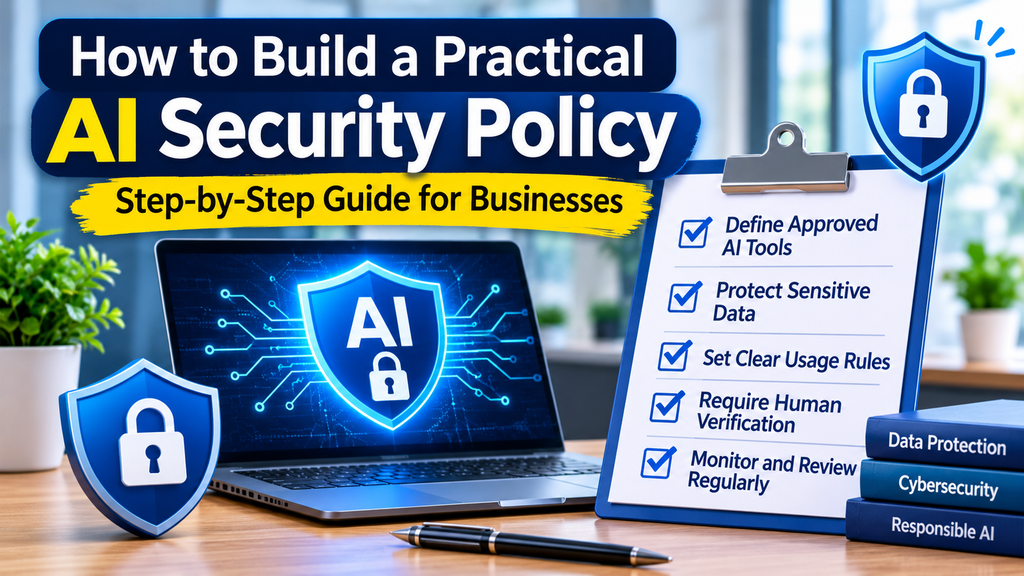
A written AI security policy helps employees understand their responsibilities and gives management a consistent approach to technology adoption.
Businesses can begin with a few straightforward steps.
Define approved AI tools: Create a list of applications employees are permitted to use for work.
Classify business data: Explain which information is public, internal, confidential, or restricted.
Set clear usage rules: Establish what employees can upload, generate, store, and share through AI applications.
Require human verification: Make sure employees review important AI-generated content before using it in business decisions.
Review vendors: Evaluate providers based on their security controls, privacy practices, contractual terms, and support arrangements.
Schedule security assessments: Test applications, review permissions, and update policies as business requirements change.
Organizations can also follow the NIST AI Risk Management Framework as a reference. Developed by the National Institute of Standards and Technology, this voluntary framework provides guidance for identifying, assessing, and managing AI-related risks throughout the technology lifecycle.
It encourages organizations to consider trustworthy AI characteristics, including security, reliability, accountability, transparency, and privacy. Businesses can use its guidance to strengthen their AI governance and make more informed implementation decisions.
Best Practices for Small and Large Businesses
AI security requirements may differ depending on company size, available resources, and the type of information being processed.
Small businesses can begin with approved AI tools, strong passwords, multi-factor authentication, employee training, and basic data protection policies.
Larger organizations may need more advanced controls, including centralized identity management, detailed audit logs, security testing, vendor assessments, and dedicated AI governance teams.
Regardless of size, every business should follow these principles:
- Start with low-risk AI applications before introducing sensitive workflows.
- Test AI tools in a controlled environment before full deployment.
- Avoid giving AI systems unnecessary access to company resources.
- Keep software, integrations, and security controls updated.
- Maintain backups and incident response procedures.
- Review AI performance and security regularly.
A gradual approach allows businesses to identify problems early and improve their security strategy as AI adoption expands.
Frequently Asked Questions
1. What is secure AI for business?
Secure AI for business means using artificial intelligence applications with suitable data protection, privacy, access controls, monitoring, and security policies to reduce risks to an organization.
2. Can AI tools expose confidential business data?
Yes. Depending on the platform and its configuration, information submitted to an AI tool may be stored, processed, or shared in ways that create privacy concerns. Businesses should review provider policies and use approved systems for sensitive information.
3. How can small businesses implement AI safely?
Small businesses should select trusted platforms, enable multi-factor authentication, restrict access, train employees, and avoid uploading confidential information to unapproved applications.
4. What is the biggest security risk associated with AI?
There is no single risk for every organization. Common concerns include prompt injection, sensitive information disclosure, insecure integrations, excessive permissions, and human mistakes.
5. Does secure AI require continuous monitoring?
Yes. Regular monitoring helps organizations identify unusual activity, review system performance, detect vulnerabilities, and respond to emerging threats.
Conclusion
Artificial intelligence can help businesses improve productivity, simplify operations, and deliver better customer experiences. However, these benefits should not come at the expense of data protection or cybersecurity.
Secure AI for business requires a combination of trusted technology, responsible employee behavior, strong access controls, regular monitoring, and clear security policies. Organizations should evaluate their AI tools before adoption and continue reviewing their security throughout the implementation process.
The best approach is to start with manageable AI projects, protect sensitive information, train employees, and introduce stronger controls as business needs grow. By making security part of every stage of AI adoption, companies can reduce unnecessary risks and build a more reliable digital future.
AI should support business progress, not create avoidable security problems. With thoughtful planning and responsible implementation, organizations can use AI confidently while protecting the information and trust that matter most.